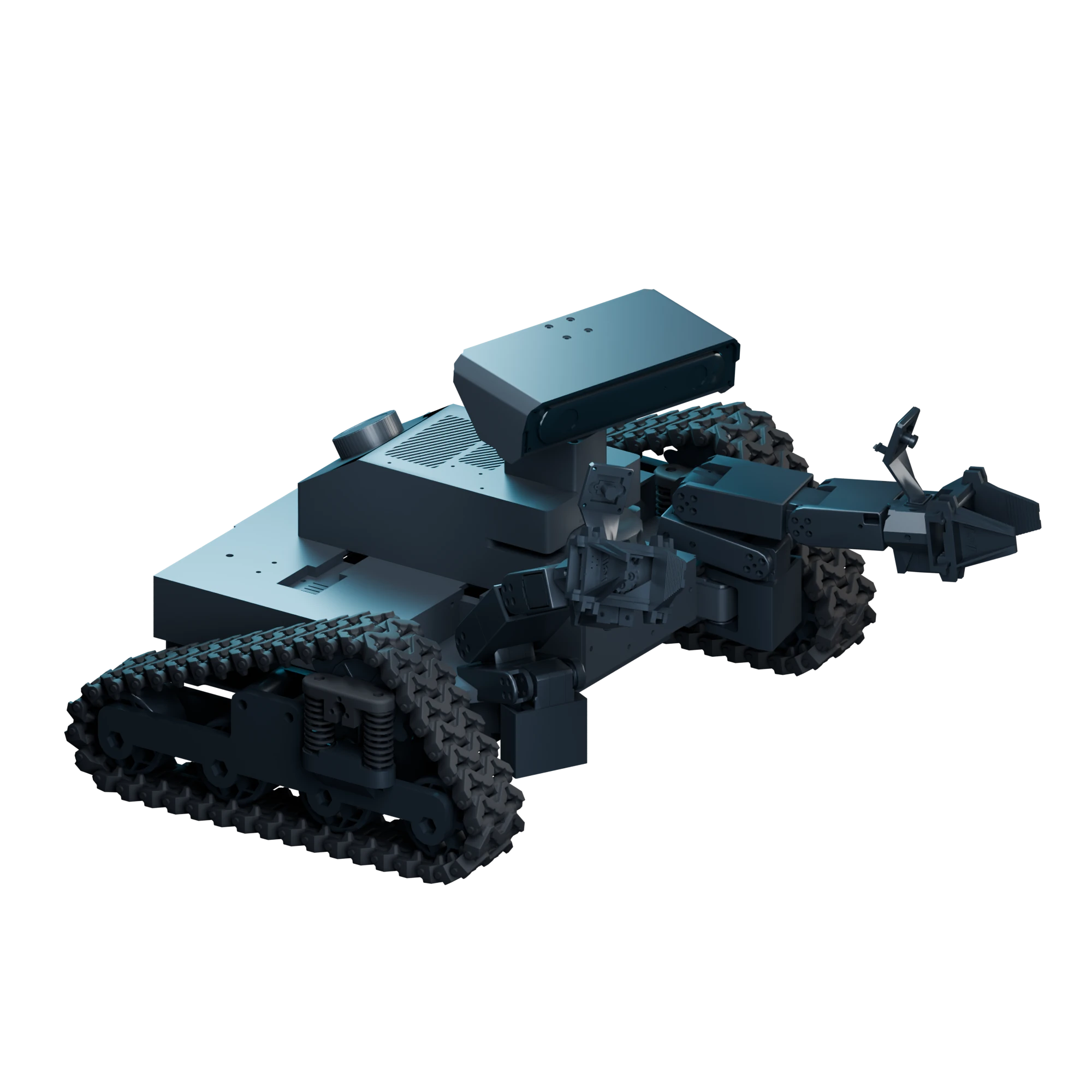
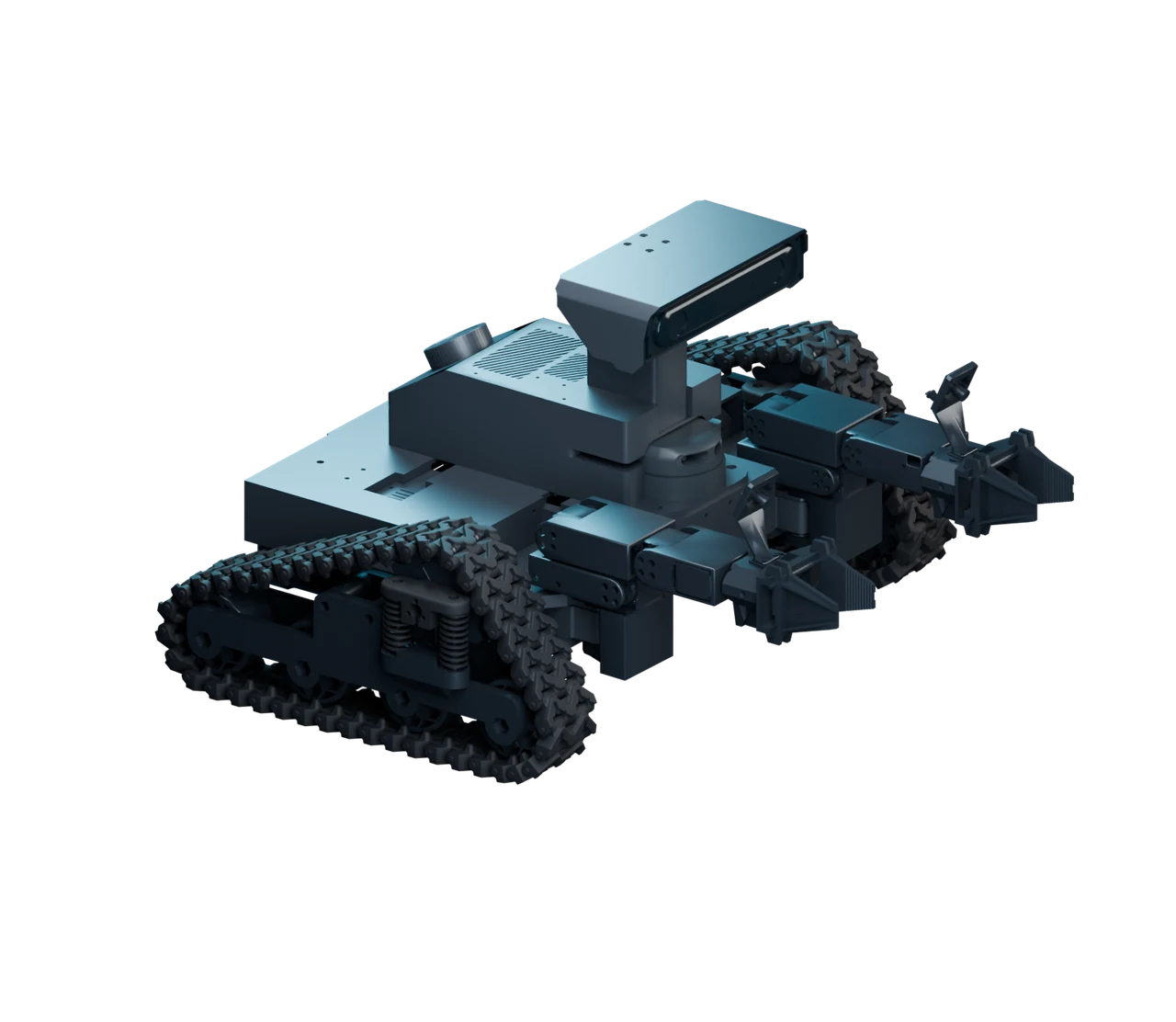
CAD-based render of Envirobot with two tracks, two articulated arms and a stereo camera head

Embodied AI / Open robotics

Envirobot.

A tracked robotics platform for embodied AI

Dual-arm hardware, stereo vision and a ROS2 control stack—with human oversight built in.

A development platform. Commissioning in progress.

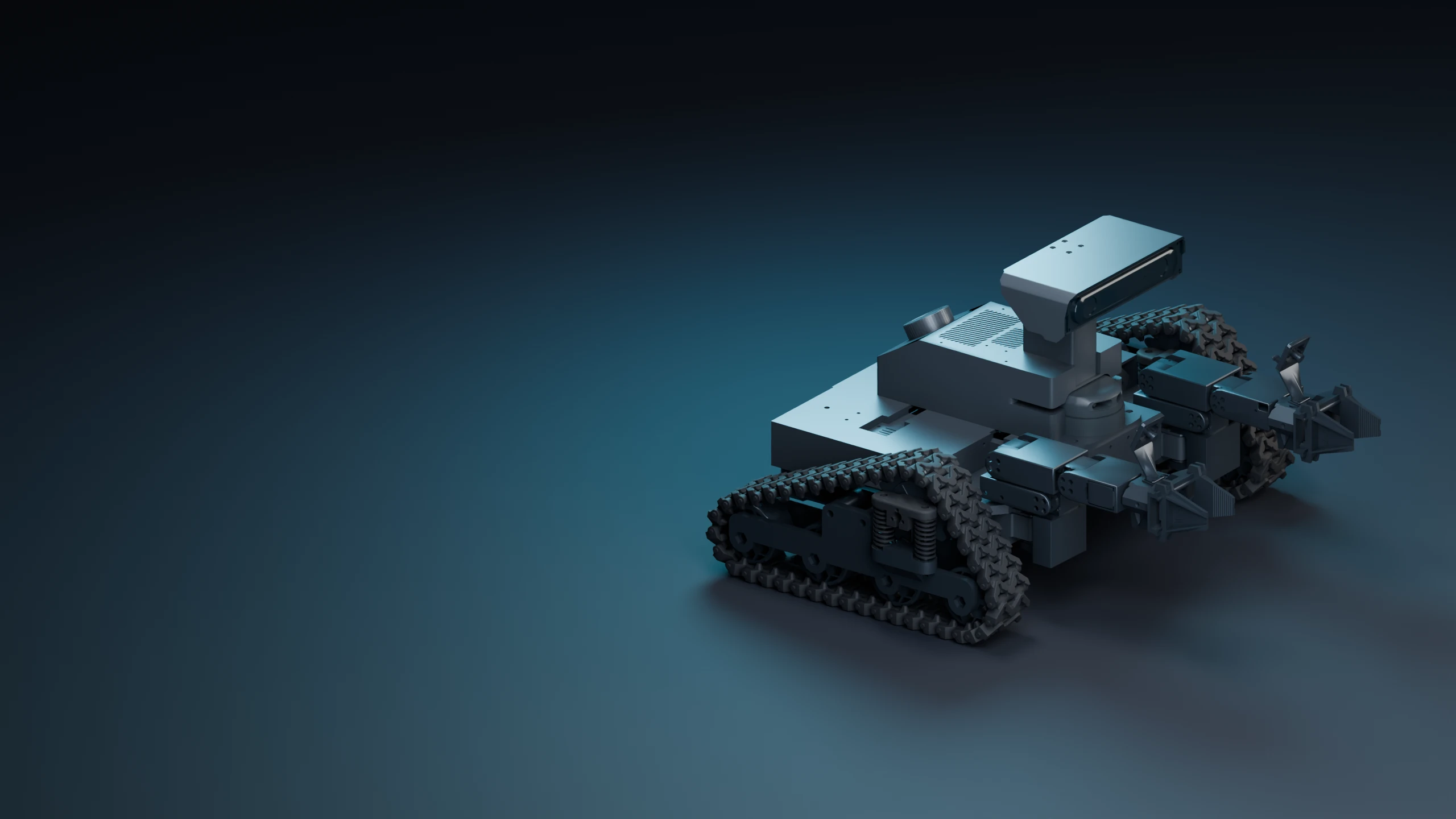
CAD-based render · proposed finish

01 / Meet the hardware

Built to move.
Designed to interact.

A tracked base, custom dual arms and a stereo camera head bring sensing and manipulation onto one physical platform.

Drive
Two DDSM315 motors driving left and right tracks.
Manipulation
Custom dual-arm geometry with SO101-compatible naming—not stock SO101 geometry. Arm integration and calibration remain pending.
Perception
ZED 2 stereo vision on a pan-tilt head. Sensor availability depends on installed, enabled hardware.
Explore the robot description
CAD render of Envirobot in an asymmetric pose, with one arm raised and the other extended
Articulated CAD study · illustrative pose, proposed finish
02 / Mechanical study

A closer look at the drive.

The right track’s original CAD components separate to expose the drive, supports, rollers and hardware, then return to assembly. An exploded visualization, not a disassembly procedure.

Download MP4

360° / Explore the hardware

Every angle.
Your perspective.

Inspect the tracks, articulated arms and sensor head from any side. Choose Explore in 3D to load the interactive model, then drag to orbit or pinch to zoom.

Envirobot in its neutral CAD pose, with tracked base, two arms and sensor head, rendered in graphite with cyan accents.

Real CAD geometry, optimized for the web. Proposed visualization materials—not as-built finish specifications. A shape viewer, not a motion or safety simulation.

Motion studies / CAD in context

A small task.
A continuous cycle.

A rendered study from Envirobot’s CAD. Simulated concept, proposed finish—not commissioned motion.

Manipulation / Kinematic study

Pick. Place. Return.

The right arm picks up a small block, places it on a marked fixture, then retrieves and returns it. The pan-tilt head follows the block throughout the continuous cycle.

Kinematic illustration only; jaw motion is estimated while gripper topology and calibration remain provisional. These studies do not demonstrate hardware capability.

Download MP4

Silent, continuous CAD studies play only while in view. Pause either animation at any time. Reduced-motion preferences show a still until you choose Play.

02 / Capabilities & readiness

Understand the stack.
Know its limits.

Software inclusion is not hardware acceptance. This register describes the architecture, not the live state of a commissioned robot.

Current commissioning boundary

Arm integration, calibration and navigation acceptance remain pending. The navigation footprint is a commissioning blocker: verify the physical envelope and clearances before enabling autonomous motion.

Core
Included in the standard software stack.
Hardware dependent
Available when the corresponding robot hardware is installed and enabled.
Optional
An installable profile or integration, disabled unless configured.
Commissioning gated
Remains disabled until credentials, safety review, and acceptance checks pass.
01Embodied Intelligence

One persistent entity hears, reasons, remembers context, and uses only approved tools.

Persistent Hermes entityCore
A subscription-backed AI identity maintains conversational continuity while reasoning about the robot and its environment.
Private local voice pipelineCore
Wake detection, local speech recognition, local synthesis, and voice-activity interruption provide the default embodied voice path with barge-in behavior.
Hume expressive voiceCommissioning gated
Optional realtime prosody, interruption, and expressive speech can wrap the same tool-enabled Hermes entity.
Context, memory, and research toolsCore
The entity can retain approved durable facts, search prior sessions, track work, and retrieve current web information.
02Perception & Awareness

Stereo vision, depth, telemetry, and typed observations turn sensor data into bounded robot context.

Stereo RGB and depth visionHardware dependent
The installed ZED 2 provides colour imagery, depth, point clouds, and camera health for operators and autonomy.
Entity camera observationHardware dependent
Hermes can request the latest safe camera observation and describe what is currently visible.
Pan-tilt visual attentionHardware dependent
A two-axis STS3215 gimbal can aim the camera while returning joint state and limits to the operator.
LiDAR situational sensingOptional
An optional LiDAR profile contributes laser scans for mapping, localization, and obstacle-aware navigation.
03Mobility & Autonomy

Manual drive, confirmed goals, mapping, and autonomous navigation share one safety envelope.

Two-track differential driveHardware dependent
Two DDSM315 motors drive the left and right tracks with differential motion and motor feedback.
Touch and gamepad teleoperationCore
Authenticated operators can drive through the desktop joystick surface or a connected gamepad with immediate stop behavior.
Confirmed autonomous goalsOptional
Nav2 path planning and goal execution support supervised point-to-point autonomy when navigation hardware is enabled.
SLAM and map operationsOptional
RTAB-Map and occupancy-grid workflows support mapping, localization, map visualization, and controlled map saving.
04Manipulation & Interaction

Jointed hardware, expressive motion, and simulation interfaces remain bounded by explicit operator authority.

Dual SO-101 arm hardwareCommissioning gated
The physical arm platform is present, but command integration and namespaced control topics remain commissioning work.
Typed actuation requestsCore
AI-requested movement is represented as validated robot operations rather than raw ROS, shell, or serial commands.
Reusable robot behavioursCore
Operators can invoke bounded high-level behaviours while monitoring progress and cancelling safely.
Explicit simulation modesOptional
Development paths support simulated sensors and actuators without pretending missing production hardware is present.
05Operator Experience

A responsive command centre combines live state, control, diagnostics, voice, and fleet workflows.

Authenticated command dashboardCore
Four authenticated operator sections—Control, HUD, VR, and Capabilities—organise action, observation, spatial presence, and system reference.
Mobile operator status shellCore
A four-tab phone shell provides HUD status, camera-first Control access, entity voice, and the capability register.
Realtime telemetry and diagnosticsCore
Live WebSocket and REST views expose robot state, motors, audio energy, containers, nodes, topics, and logs.
VR teleoperation workspaceOptional
An optional Quest/VR bridge supports immersive monitoring, recorded sessions, and safety-scoped teleoperation.
06Safety & Operations

Safety is enforced below the AI and shared across every operator, voice, navigation, and VR surface.

Global E-stopCore
One latched emergency-stop state blocks physical motion across dashboard, voice, autonomy, and VR control paths.
Typed capability gatewayCore
All AI-requested physical actions cross an authenticated schema and policy boundary before ROS or hardware.
Confirmation and deadman controlsCore
Risky goals and actions require bounded confirmation while drive and VR paths require fresh operator presence.
Isolated, observable operationsCore
Health checks, bounded logs, secret isolation, container limits, and explicit profiles support recoverable deployment.

From the shared capability register · revision 2026.09.23 · Read the technical documentation ↗

03 / Operator experience

One robot.
A human in the loop.

Persistent Hermes entity for context and approved tools. An authenticated dashboard for the operator—not an unrestricted path from conversation to motion.

Open operator console
Talk

Voice, with configuration in view

The local Whisper / Piper path supports conversation and interruption. Hume expressive voice is optional and commissioning gated.
Observe & control

The actual operator console

Inspect telemetry, camera views and navigation tools through authenticated surfaces. Available data and actions depend on connected hardware and enabled services.

Extend

VR is an optional interface

The Unity integration is an additional development path, not a requirement or a latency guarantee. Hardware acceptance still applies.
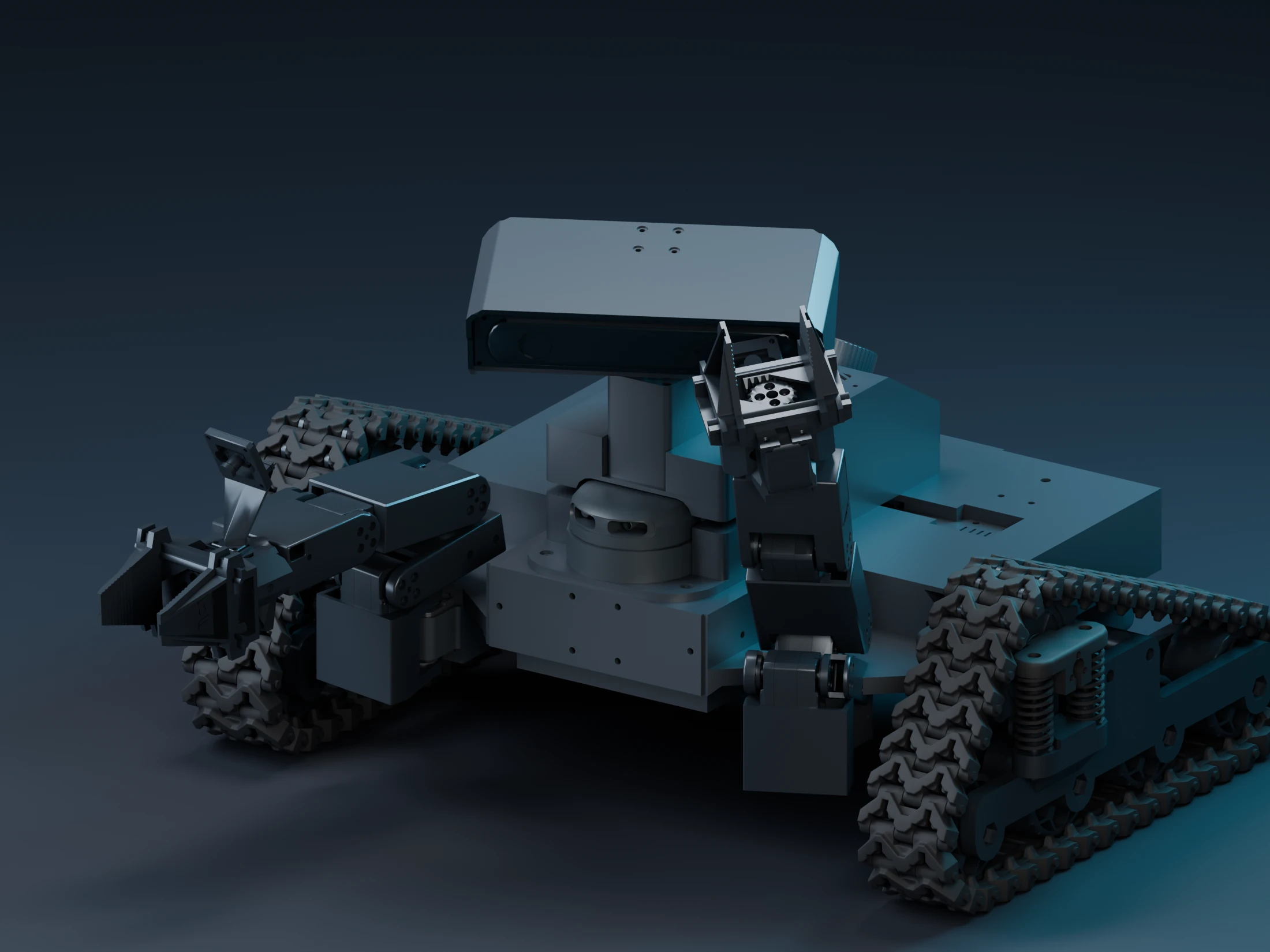
Articulated CAD detail of Envirobot with a raised gripper and camera head turned toward that arm
Articulated CAD study · not a calibrated or safety-validated pose

04 / Safety by design intent

Reasoning is not
permission to act.

Typed capability gateway, explicit confirmation for gated actions, audit trails and Global E-stop are part of the control architecture.

  1. RequestOperator or entity proposes a bounded action.
  2. CheckAuthorization, limits and required confirmation are evaluated.
  3. Act or refuseThe gateway enforces the safety state; E-stop blocks motion.

Architecture overview—not a safety certification. Software safeguards do not replace physical emergency stops, risk assessment or supervised commissioning.

05 / Build & contribute

Bring your curiosity.
Work from the source.

Explore the code, inspect the hardware and help close the commissioning gaps. Start with the documentation and current limitations.